
Riverside, CA · Garage Door Service
Weather Seals and Drafts: What Riverside's Housing Stock Means for Your Door
Riverside homes built mostly in the 1980s and 90s get brittle, sun-baked seals before they get frozen ones. Here's what that means for your door and your bill.
- Repairs & new doors
- Springs & openers
- Serving 5 nearby communities
The Cost of This Job
We're not going to hand you a number here, because a seal job isn't one job. A bottom seal swap on a single door is a different ticket than stripping and replacing side and top weather seal on a double door with warped track, and the gap between them is real. What we can tell you is what drives the cost on a Riverside house: door age, track style, and whether the jamb itself has shifted enough that a straight seal won't sit flat anymore.
Riverside's housing runs from 1938 up through 2007, with the midpoint sitting around 1983. A door from that era usually has a steel section with a foam-core seal channel that was never meant to be opened twice. If the vinyl's dried out and cracked off in pieces, you're often buying a full retrofit kit rather than a strip of replacement seal, and that's where the price moves. A straightforward bottom astragal swap is a short visit. A full perimeter reseal on an older frame, where the track or stop needs adjusting too, takes longer and costs more. We'll tell you which one you've got before we start, not after.
When to Call Someone
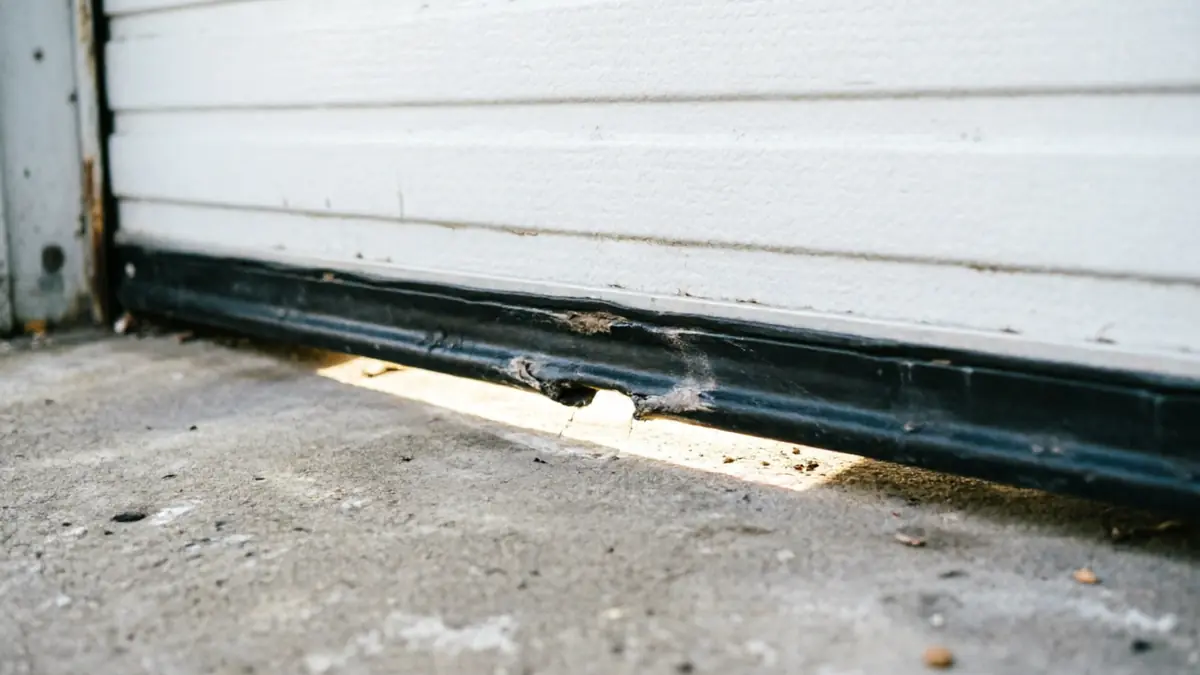
Daylight showing along the bottom edge of a closed door, or a line of dust sitting on the garage floor that wasn't there last season, both point to a seal that's done its job and quit. On a lot of Riverside houses built in the 1980s and 90s, that failure shows up as cracked, hardened vinyl rather than a torn strip - the rubber's gone brittle from years of heat, not from wear.
If the seal's just flattened or has one soft crack, that's a kit you can often swap yourself with a utility knife and twenty minutes. Call someone when the seal keeps pulling loose after you've reseated it, when the track it rides in has rusted or bent, or when the gap is uneven across the width of the door - that's usually a sign the door itself has sagged or the opening has settled, and a new seal won't fix a problem that isn't about the seal. We'll also say plainly: if the door is original to a 1960s or 70s build and the panel's warped, a new seal kit is a band-aid. At that point you're better off pricing a new section or a full door.
The Situation
Riverside's housing didn't go up all at once. Homes range from 1938 through 2007, but the bulk of what's on the ground across the roughly 30 named areas we cover - Hawarden Hills, Magnolia Center, Victoria, Ramona, Alessandro Heights, Arlington, Canyon Crest, Mission Grove, Rubidoux, Arlanza, Orangecrest, La Sierra South, and the rest out toward Woodcrest, Mead Valley, and El Cerrito - dates to the 1980s and 90s. That matters for seals because it means most garage doors in this service area share the same era of hardware: steel sectional doors with a routed track for a bottom astragal and a tacked-on side/top seal, not the newer compression-style retainer you'll find on anything built in the last decade or so.
Across the service area there are 253,379 households and 138,547 owner-occupied houses, and a good share of those sit on this same 1980s-vintage door. With a median household income of $90,208, most owners we talk to would rather spend on a seal kit now than pay for it in a summer electric bill later. It's a common call, not an unusual one, and the fix is usually straightforward once we know which door generation we're dealing with.
What Local Conditions Do
Riverside sits in a moderate heat band, not an extreme one, and that shapes what actually fails on your door. We're not dealing with freeze-cracked rubber the way a colder climate would. What we see instead is UV breakdown: vinyl and foam seals that sit in direct afternoon sun for years and go stiff, then crack into short segments instead of tearing as one strip. That's a slower failure than a freeze split, but it's just as real, and it's why a seal that looks fine in January can crumble by August.
Dust is the other piece. A dried, cracked seal doesn't just let in air - it lets in fine grit that settles on stored items and works into track hardware over time. On older 1980s-era doors with a shallow bottom channel, that gap opens up faster once the seal starts to go, because there's less rubber holding the shape. None of this is dramatic weather - no ice, no hail damage - but moderate heat sustained year after year does the same job on rubber that a hard winter does somewhere else. It just takes longer to show.
Frequently asked questions
How often do garage door seals need replacing in Riverside?
There's no fixed interval we can promise, since it depends on sun exposure and the door's age, but UV breakdown is the main driver here rather than cold cracking. If your seal looks chalky, feels stiff, or has started breaking into short pieces instead of bending, it's past its useful life regardless of how many years it's been.
Can I replace a weather seal myself?
Often, yes. A bottom astragal kit on a standard steel door is a reasonable DIY job with a utility knife and some patience. Where it gets harder is on older 1980s-era doors where the track channel has worn or the seal has hardened into the groove - if it won't pull free cleanly, that's a sign to call rather than force it.
Why does my garage floor get dusty even with the door closed?
That's almost always a failed bottom or side seal letting fine grit through, not a sealed-concrete problem. Riverside's moderate, sustained heat dries out vinyl and foam seals over time, and once they crack, dust finds the gap even when the door looks closed and tight.
Related garage door services in Riverside
More garage door guides
Book garage door service in Riverside
Call now or request a quote - tell us what the door is doing and where you are.