
Riverside, CA · Garage Door Service
Garage Door Roller Replacement for Jurupa Valley Homes
Jurupa Valley homes built around 1980 still run steel rollers on original track. We replace worn rollers and explain what a 44-year-old door is actually working with.
- Repairs & new doors
- Springs & openers
- Serving 5 nearby communities
Why It Happens Here
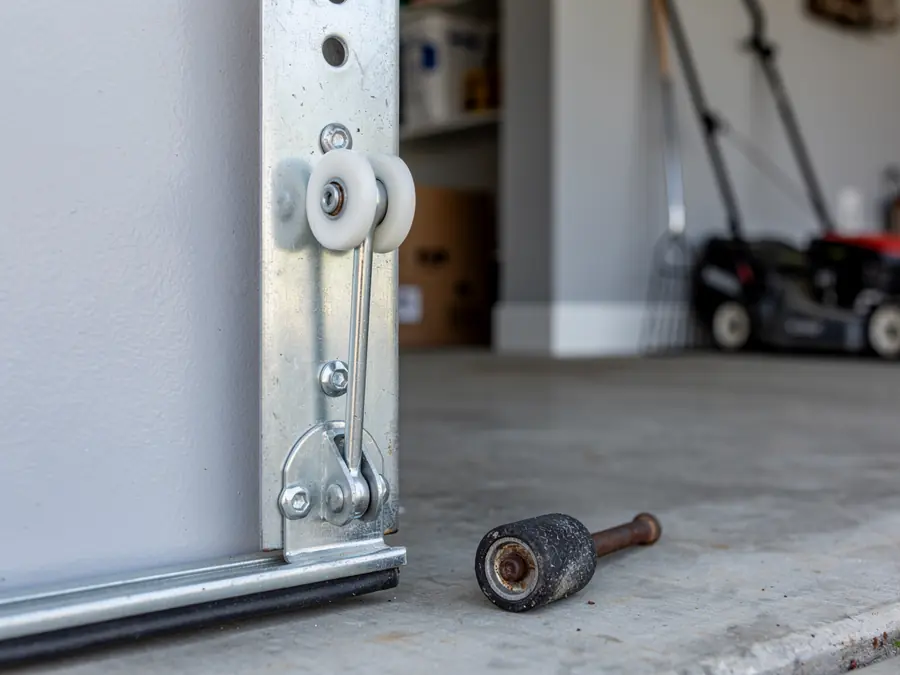
The fault we see most in Jurupa Valley is steel rollers that have worn an hourglass groove into themselves from running dry in metal track for decades. That's not a generic wear-and-tear line - it's what you get when a house was built around 1980, which is the median year for this area, and the door never had its original hardware swapped out. Builders in that era hung doors with steel rollers on steel track almost universally. Nylon rollers with sealed bearings weren't standard practice yet, so a lot of these doors are still running the parts they left the factory with.
Steel-on-steel doesn't fail quietly. It grinds, then it chips, then a roller stem snaps off inside the track and the door jumps off its rail mid-cycle. Add in the moderate heat this area sees - enough daily temperature swing to dry out whatever grease was on the track originally - and the wear accelerates on a door that's already 40-plus years into its service life. This isn't a Riverside-specific problem dressed up with a different city name. It's a function of when the neighborhood went up.
How It Shows Up
You'll usually hear it before you see it: a rhythmic grinding or clicking as the door travels, loudest right where a bad roller rolls through the curved section of track near the top. On a steel-roller door from this era, that curve is often the first place metal-on-metal wear shows because it's where the roller carries the most side-load.
Some owners notice the door hesitating or jerking at that same spot on every cycle - that's a roller that's gone from round to oval and is catching on the track edge rather than rolling through it. Left alone, the stem can shear, and the panel drops out of track on that side. If you're getting a visible gap between a panel and its roller bracket, or the door looks slightly racked when it's partway open, stop running it and get it looked at before the track itself bends.
What the Repair Takes
On a door from the 1980 era, we're not just swapping rollers - we're checking whether the track itself is still straight after 40-plus years of metal rollers grinding through it. If the track has worn grooves or is bent from a roller seizing, that gets addressed too, because new rollers in bad track just wear out again in a year.
We replace the steel rollers with sealed nylon units, which run quieter and don't need the periodic lubrication steel rollers demand. On a standard double door we're pulling and replacing rollers on both sides, checking the hinges they ride in, and making sure the stems seat properly in the track radius. One honest limitation: if the track is bent badly enough, roller replacement alone won't fix the symptom - that's a track repair or replacement job, and we'll tell you that up front rather than sell you rollers that won't solve it.
How Long You Are Without the Door
A straightforward roller swap on one door, with track in decent shape, is typically a same-visit job - the door goes back into normal use before the truck leaves. If the inspection turns up bent track or a hinge that's cracked from the same wear pattern, that adds time to the visit but it's still usually resolved in one trip rather than requiring a return visit.
What changes the timeline is parts availability for anything beyond standard rollers and track - if your door needs a less common panel or hinge replaced alongside the roller work, that piece may need to be ordered, and we'll tell you that before starting rather than after.
The Cost of This Job
We don't have a posted price for this job to quote here, and giving you a number without seeing the door and its track condition would be a guess dressed up as a fact. What we can tell you is what drives the cost: whether it's rollers alone or rollers plus track straightening, how many rollers are worn versus just the ones making noise, and whether the hinges they sit in need replacing too. A door that's been running dry steel-on-steel for over 40 years in this area often needs more than a parts swap, and that's the honest answer rather than a flat number that doesn't hold up once we're looking at your actual track.
Frequently asked questions
Why do Jurupa Valley garage doors seem to wear out rollers faster than newer builds?
Houses here were mostly built around 1980, and doors from that era shipped with steel rollers running in steel track - no sealed bearings, no nylon. Four decades of that wear grinds grooves into the rollers and sometimes the track itself, which is why roller noise and binding shows up more here than in newer stock.
Can I just replace the noisy rollers myself?
You can, but on a door this age we'd check the track first. If 40-plus years of steel rollers have worn or bent the track, new rollers alone won't stop the grinding or the jerking - you'd be fixing the symptom and leaving the cause.
Do you have a shop or branch in Jurupa Valley?
No - we're based in Riverside and travel the roughly 6 miles out to Jurupa Valley for jobs like this. We don't maintain a local depot here, so we schedule the visit rather than offer walk-in service.
How many rollers usually need replacing on one of these older doors?
It depends on the door, but on a standard double-car door we're typically replacing rollers on both sides rather than just the one that's audibly failing - if one roller has worn to an oval from 40 years of steel-on-steel, the others on that door are usually close behind it.
More garage door services in Jurupa Valley
Book garage door service in Riverside
Call now or request a quote - tell us what the door is doing and where you are.